Showing posts with label vegetarian. Show all posts

Tuesday, December 8, 2015

Butternut squash - easy peasy!

Don’t get me started about how much I love squash... and in particular, that gem among the squashes: BUTTERNUT!
Seriously – don’t.
Here you are already on my blog, though, so permit me to ramble a bit about butternut squash. If you make it through the whole post, I guarantee that you will want to run, not walk, to your nearest produce section, and buy a beautiful big, weighty, smooth-skinned, pale caramel gold butternut squash and make it for yourself this very night.
First, the skinny on nutrition. A cup of baked butternut squash has 82 calories, contains almost 60% of your daily Vitamin A, over 40% of daily Vitamin C, 13% of your thiamine, 14% of the niacin you need, and almost 9% of your daily calcium requirement! 
Fiber is, alas, negligible, but squash – winter squash in general – is REPLETE with amazing phytonutrients and other goodies.
Yes, there's lots of carbohydrate, too, but according to my go-to nutrition source:

"We think about winter squash as a very starchy vegetable—about 90% of its total calories come from carbohydrate, and about half of this carbohydrate is starch-like in its composition. However, recent research has made it clear that all starch is not the same, and the starch content of winter squash brings along with it some key health benefits. Many of the carbs in winter starch come from polysaccharides found in the cell walls. These polysaccharides include pectins—specially structured polysaccharides that in winter squash often include special chains of D-galacturonic acid called homogalacturonan. An increasing number of animal studies now show that these starch-related components in winter squash have antioxidant, anti-inflammatory, as well as anti-diabetic and insulin-regulating properties."

From a health perspective eating squash is a no-brainer.  But how to cook it? It's surprising how many people are daunted by the idea of cutting a squash open and dealing with all the seeds.  And it's true that getting through the outer shell of some winter squash can be a challenge. I recently found a recipe for roasting a butternut WHOLE, and it made my day – blew my mind – changed my life!
Here’s what you do.
  • Wash the squash.
  • Place it on a baking sheet in a 400 degree oven.
  • Walk away.

When you come back about an hour later – just to check – you’ll be able to tell if you need to roast it a little more.
How to tell? The top surface will have a slight (slight) char, and you’ll be able to insert the tip of a sharp knife with ease.
A whole roasted butternut squash is HOT, so when it's done pull it out of the oven and wait about 20 minutes.  Then cut it in half, scrape out the seeds (infinitely easier when everything is soft) and feast!

I like my squash topped with just a soupcon - okay, a tablespoon full - of butter and a sprinkle of my new favorite salt: Maldon salt.   But it's also wonderful topped with a shake of ground cinnamon and a drizzle of maple syrup, or whisked into a strong brown veggie stock to make a pure and vibrantly flavored squash soup.  I even like roasted squash cold the next day - a touch of salt brings out the unctuous natural sweetness.

Low in calories - nutrient dense - ever so tasty - and even slathered in butter it's 90 percent vegan: what's not to like?

Chili - it's what's for dinner!

Shaky cam!


What's more delightful in the bleak midwinter than a hearty, warming bowl of chili?

The one-pot wonder (shown in the early stages above) is 90 percent vegan, yet full of that lovely umami taste from a judicious amount of meat.

I used sustainable, local ground beef - just a half pound for the entire pot, or about an ounce a serving.  To coax even more richness out of the dish, I added mushrooms, which are well known in veggie circles for their meaty flavor.

Here's the "recipe," such as it is.

1 large tomato, diced
1 large orange bell pepper, sliced in rings
1 large green bell pepper, sliced in rings
1 large jalapeno pepper, seeded, sliced in rings
2 large onions, diced
3 ribs celery, diced
1 bunch green onions, sliced on the bias
1 lb button mushrooms, diced
1 can jalapenos packed in chipotle sauce
2 large cans peeled tomatoes packed in their own juice
1/2 lb local, sustainable, grass fed beef, ground
salt and pepper to taste
palm full of plain old chili powder

Add a dollop of olive oil to your heavy bottomed soup pot and brown the ground beef.

When it's almost completely brown, add the mushrooms and saute until they're also brown and have given up their liquid.

Add the onions and celery and saute for a few minutes - they should just start to pick up a little color.

Add everything else EXCEPT for the canned goods and saute for about 5 minutes - again, just to get things started.

Now crunch the tomatoes a little with your fingers and dump them in, along with the canned jalapenos.

Bring chili to a simmer and let it cook for at least 20 minutes to get the flavors going.  Longer never hurt anyone... and this is excellent the 2nd and the 3rd day!

Obviously, adjust seasoning to your taste.  You can add hot sauce, more chili powder, smoked paprika.... it's very much up to you.

The point is - it's chili, it's made with meat, it's delicious, and it's 90 percent vegan. For the win!

As for a picture of the completed chili?  We ate it up too fast to get a shot.

Arnold has dropped the mic

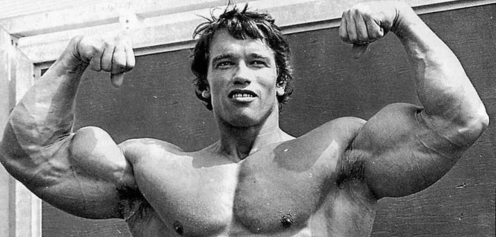
Arnold Schwarzenegger is making news today, talking about climate change and urging people go partially vegetarian.  So I thought I'd dust off this blog and see if I could add anything of value.


It occurs to me that recipes and tips might be just the prosaic, down-to-Earth help that some folks need to make the move from eating meat.  It's all well and good for celebrities to encourage dietary changes that will "save the planet" (not my favorite phrase) but actually doing something about that - actual people making actual changes - that's an entirely different story.

Americans eat a LOT of meat.  Over 270 pounds per person, per year.  While that's nowhere near as much as a steer weighs (an adult male averages over a ton) it is still a LOT of meat.  Going 90% vegan would mean reducing one's (average) consumption to just 27 pounds of meat per year - about a half pound a week, or two 4 ounce servings.

Looked at another way, if you need 2000 calories a day to fuel yourself, that means 200 of them could come from animal sources a day, more or less.

My recommendation - going 90% vegan - is just what it sounds like.  Get at least 90% of your daily calories from plants, and no more than 10% from local, organic, free-range, sustainable animal sources.

Schwarzenegger says that asking people to go completely vegan or vegetarian is asking too much, and I hate to admit it, but he's right.  As a vegan I got more than my fair share of horrified gasps and blurted comments, along the lines of "I could NEVER give up MY bacon!" and "What do you even EAT?!?!" so I know that most folks - that is, most Americans - aren't going to give up all of their animal protein.

But 90 percent vegan?  I think that's do-able.  Even 80% vegan is better for the planet than not trying to reduce your calories from unsustainable factory-farmed meat.  It’s something I think every American can do - and SHOULD do - for some pretty obvious and simple reasons. It’s good for your:

Waistline

Wallet

And it’s also good for the

World

Not sure anyone would argue that going 90% vegan is good for one’s waistline. As a 100% vegan I lost 60+ pounds - then gained those pounds right back when I tool to eating meat again.

You might think this is a pretty shallow reason to go 90% vegan – but if that’s what motivates you, who cares? Anyway, dropping that extra avoirdupois should be good for your health. Lower blood pressure, etc., etc. is a good thing!

As for your wallet – well, it’s certainly a no-brainer that you can save money if you’re not buying meat and dairy. While it is certainly possible to inflate your grocery bill if you aren't a careful shopper, eating at home more, cooking from fresh ingredients, and replacing expensive cuts of meat with whole grains and beans and tofu can make a big difference to your bottom line. The savings aspect of this will be the subject of posts explaining HOW.


Finally, while it might not be immediately apparent to many that going 90% vegan can help save our planet from global climate change, in fact, it CAN.  Here's Mikko Alanne's great blog post explaining the concept.

It's been a year since my last post, and in the interim I've been blogging over at at the Daily Kos as well as trying to keep up my own climate change blog.  Let's see if I can get my fingers flying even faster, and start posting recipes and shopping tips here!

Thanks for reading... and please (really, this time) - stay tuned!